HORSETALK CLIPBORAD
Topical Management Issues currently covered on the CLIPBOARD are:-
 |
|
WINTER BODY CHECKS
With the advent of the shortened days it means that many horse owners are attending to their horses each morning and evening by artificial light of varying effectiveness, especially during the week when they are at work and so on. However good your lighting system is though, no light is as good as natural light. This means that at the times you do see your horse in proper daylight it is important to check him over thoroughly for any little cuts, lumps and bumps that you may have easily missed previously. This is equally applicable to the stabled horse as the turned out horse as things can easily go undetected under rugs.
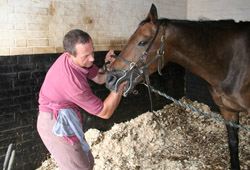
So make it a policy to give your horse a very close inspection every few days from hoof to ears to check for anything unusual such as a swelling, check for scabs especially on the legs as these can easily be hidden by winter feather, check the mouth and teeth, underneath the elbow and up between the hind legs are also areas where little cuts and scratches can go undetected.
For the winter woollies it is important to bury your fingers into the thick coat over the entirety of the body and legs to ensure a thorough check; this also provides a good opportunity to check for any weight loss - a thick winter coat can hide a rather lean torso. Make sure also that all is well with shoes and that the feet are generally in a healthy condition. The stabled horse is just as prone to such diseases as thrush as the turned out horse and in many cases more so because at least the horse at grass is moving around more and so stimulating the frog. Srubbing the feet and dosing with a mild bleach will help guard against any nasties.
Horses that are turned out with rugs on need proper checks to ensure that no areas are becoming sore from chaffing; there are various products on the market to protect the delicate shoulders and withers, but the spine and hips can also suffer, especially on thin skinned horses. The problem is not necessarily caused by rugs that do not fit properly but the pressure exerted by the sheer weight of some of them.
FEEDING - AVOIDING BEHAVIOURAL ABNORMALITIES
Well, to be honest we find it to make perfectly logical sense as part of the management regime, that a horse should be fed as naturally as possible i.e. as close to how he would feed if he were out in the wild. However this is not always quite so simplistic as it would appear especially for the competion horsre but with a little thought much can be done to mimic that wild state even for the stabled horse.
A scientific study has been done experimenting with different forage feeds and reactions monitored. However at the same time the research foods but the project highlighted just what a boring diet the majority of horses have, yet "variety is the spice of life".
The trouble is today is that either people are not prepared to put time and effort into and follow the basic rules of feeding - they are happy to forget about a horse's natural feeding habits, tip a bowl of compound feed into the manger and a slice of hay in the rack and that's it, job done – or they just don't have appropriate knowledge.
We had this conversation at the weekend with clients – after a few riding lessons, so many people decide owning a horse is for them, but have received no guidance in any of the management, welfare and veterinary issues they need to be knowing about.
Anyway, getting back to the topic in hand. Ok, so it is accepted that for many it is just not feasible to have a horse turned out 24/7; however ideal and natural this of course is, if you are getting Dobbin ready for a major competition, there is no way you can keep him at the peak fitness if he is munching grass for 22hrs a day. So, as in all other aspects of management, feeding has to mimic nature as much as possible.
To this end, variety in the diet is very important. Part of the trouble is concern about causing digestive upsets because there are warnings at every corner about colic when dietary changes are introduced too rapidly. This of course is a good warning to heed, but we mean regular variety that is continually taking place, not just once in a blue moon.
Think for a moment how you would feel if you lived in the same room every day of every week, every month and only came out of it for about 2hrs a day, had the same meal put in front of you three times a day and that was it, your daily life? You would soon become pretty cheesed off and no doubt develop some unpleasant habit that was socially unacceptable or bad for your health, or both!
So rather than feeding just a plain old mix (which of course there is nothing wrong with, it's just a bit boring) spice up your hard feeds by interchanging with cooked feeds such as barley and linseed, add some soaked oats or a little honey if you need to tempt the fussy or shy feeder; pull up grass (or better still, complete sods) and herbage (nettles, dandelions - everything unless of course it's poisonous) for your horse to rummage through; put large carrots/apples on the floor for him to chomp at; some horses like things such as sprouts - do not feed these whole, pull the outer leaves off and give those- or a swede or play with and finally munch on; rather than always feeding chaff type products as a "filler" i.e. mixed in with other hard feed ingredients, dampen it slightly, spice it up if necessary, depending on the actual product, with a little something and feed it on its own off the floor.
Remember that basically you are just trying to mimic nature by giving your horse a much more varied diet more akin to what he would get if he was roaming freely; make him work a little for some of it by rummaging about and eating from the floor rather than a manger. The fear is for some that by encouraging a horse to eat off the floor, he will then turn to eating his straw bed because he think that's food too. Well, if your horse is fed an appetising diet he won't find straw very exciting and for those that are confirmed bedding eaters anyway then no doubt they are already bedded on an alternative.
Unless a horse proves to be particulary wasteful we do not use racks or nets for hay/haylage as it far better for a horse to adopt a "grazing stance" to eat; many people set hay racks and nets too high anyway as a reaction to concern about nets in particular being too low (risk of legs getting caught, etc.) Years ago, the practice was in racing yards to sweep a patch of bedding back and feed even the hard feed from the floor - far more natural and time consuming for the horse.
The old adage of feeding little and often is of course so true but again not always feasible but do try to split hard feeds as much as possible; if your horse does have the tendency to eat his hay/haylage a bit too quickly, then increase the time span by using a small-holed net - just make sure it is tied up high enough.
Remember that the majority of undesirable behavioural habits develop through boredom!