RETRAINING for RACEHORSES.
Re Educating the Racehorse - A Life After Racing
Please refer to "Stop Press" further down this page
RE-EDUCATING - is term we prefer to use to describe the process of re-training for horses that have been raced either on the flat or over hurdles and fences.
WE work very closely with the RoR being Training Consultants to the Charity as well as running the Helpline.
WHAT happens to the 4,000 plus horses which come out of training every year is an issue which is particularly close to our hearts and the re-educating of these horses is something that we are something that we are very passionate about. To this end working with such horses comprises quite a large proportion of our work.
WE take this opportunity to point out that the thoroughbred horse is not for everyone, so you should take plenty of advice and correctly assess your own abilities both in and out of the saddle before deciding to re-home such a horse. IF you equate the re-training of these horses as being akin to starting off a young horse, then if you do not consider that you could not do this, then possibly a racehorse is not for you. HOWEVER there is plenty of help available if you ask, even if it means your horse having a spell at a retraining yard to establish the basics. Challenging as it can be sometimes - as indeed any horse can be - it is an extremely rewarding process.
|
THE re-schooled racehorse can, in the right hands, provide considerable pleasure and fun and be quite capable of competing at levels which suit the vast majority of riders.
WHILST sadly it has to be admitted that not every horse that has been in training successfully makes the transition from racehorse to riding horse in that one of two do retain a degree of unpredictability or inconsistency in their behaviour, the signifciant majority can be directed along other paths given the time, patience, correct handling, understanding and traini,. So do not think that every "ex-racehorse comes out breathing fire and wants to tear off at every opportunity"; there is much fun to be had.
|
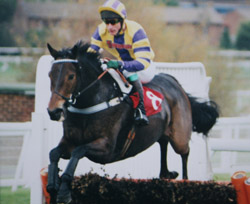
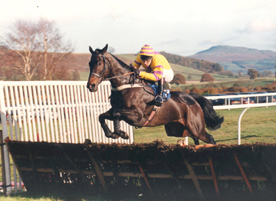
ADRIAN MAGUIRE on "Arterxerxes" at Aintree when in training with Clive Cox. FOLLOWING a leg injury it was decided to retire the horse from racing, rather than risk a recurrence of the injury. |
|
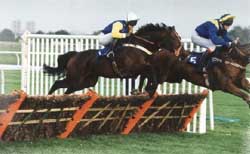
ARTERXERXES is just one of many horses we have rehomed. |
HORSES that have been flat raced can sometimes be a little more difficult to work with than National Hunt horses because, in simple terms, they have taught to go from A to B as fast as possible, speed being the all important factor; for NH horses the test is jumping accuracy and stamina.
WHEN beginning a programme of re-education we are mindful that we are dealing with a horse that thinks it already knows is required of it, unlike starting with an unbroken horse; Also, the horse is required to change its whole of way life and thinking. It is long process and extreme patience is the criterion for success – even most seemingly simple factors all come into play.
FOR EXAMPLE even the yard routine will be very different to that which the horse has been used to and that in itself can have a very unsettling effect. And remember that mounting from a block is something the racehorse never encounters and it certainly will not be used to being tied up outside its stable! One of the biggest factors though is bitting - the ex-racehorse does not fit in to the normal mould of bitting principles so do not expect your horse to go in a particular bit because "the book" says he should!
Whilst undergoing re-educational training, we constantly assess each horse so as to be able to give a realistic appraisal regarding its future life.
Flat horses
REMEMBER that these horses have been broken as yearlings so have had to mature very quickly and this can have a tremendous mental impact which some do not ever satisfactorily overcome or do so but to varying degrees. Thus it is important to be realistic about possible future careers for such horses, in that for example, they may just become too uptight and stressed, however well the physical training has gone, to be able to accept the excitement and activity of a showground, so the less claustrophobic environment of cross country (hunter trials, jump cross, etc.) may be an suitable alternative. Having said that though, many flat horses make a successful transition to the polo field.
"Hero Worship"
 |
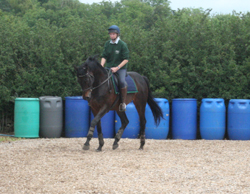 |
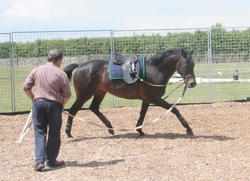
THIS little gelding had a very illustrious start in life as he was part of the Godolphin team. He found his way into the Darley Rehoming programme and then, having been rehomed, was sent to us to further his re-education. Hero is a super little chap - a little on the cheeky side, but all in good fun as he is such a kind natured person.
 |
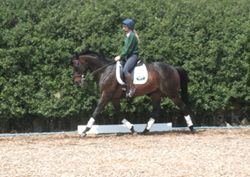 |
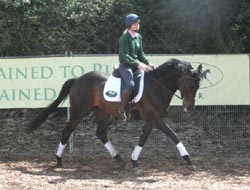
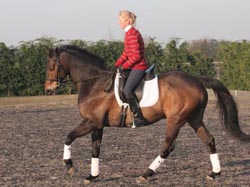
HERO WORSHIP was a little stuffy in his movement when he first arrived and did not properly accept the contact and move forwards into the bit. However in just 9 weeks he changed dramaticall and these photographs illustrate, he would now readily grace the dressage arena or, as he is also extremely attractive, would not be out of place in the show ring either.
National Hunt horses
USUALLY these horses have had a little longer to mature (unless they have flat raced before going hurdling). Increasingly these days more and more NH horses are receiving a degree of schooling as trainers have come to realise the benefits such work has on a improving a horse's jumping accuracy. This of course all helps the re-schooling process as 'a disciplined way of going' is then not quite such an alien experience.
"Leosaid" - Georgie to his friends and family
LEOSAID stopped racing due to a check ligament injury; he required several months of walking before exercise and re-training proper could begin and this did not help his already difficult temperament and behaviour - rearing and then walking backwards was his favourite party trick!
THIS little horse was extremely sensitive, not just mentally, but physically too. His re-training has been a wonderful experience although the road has been a bit bumpy at times. However he has been a terrific little chap to work with all despite his quirks and phobias – but that's his personality and character. He has been proof of how it is possible to work with a horse in a way so as to overcome what could be an obstacle if you let it become one. From being a horse that would not even step over a pole on the ground without 'throwing a wobbly', perseverance has prevailed and solid timber holds no fears.
|
LEOSAID almost died in 2004 from an unidentifiable intestinal bacterial infection. However he pulled through and continued to live life to the full for another 3 years. Sadly in August 2007 he was put to sleep having suddenly lost the use of his hindlegs. He will remain a feature of this website as he was such a fabulous little horse to own and work with; we loved him dearly despite all the challenges he would throw up. |
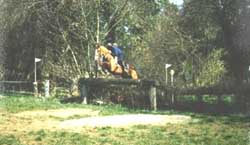
"Mr. Bojangles"
THIS gelding was one of the most successful ex-racehorses competing in the dressage arena. He has a super temperament and is very straightforward so therefore has proven to be is very trainable - as evidenced by the fact that despite being ridden by several different riders in the dressage arena, all have had great success with him. Having moved to Paul Hayler's yard, Bo he competed sucessfully at Advanced Medium before his retirement.
|
|
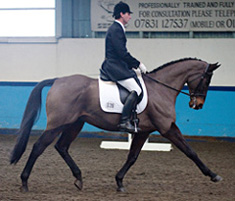
"THANK YOU" to John Tyrrell for the photograph of Mr. Bojangles and Paul Hayler.
|
NORMAN WILLIAMSON riding "Light the Fuse" when in training with Kim Bailey. |
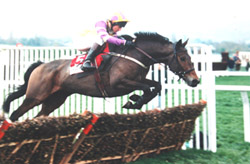
"LIGHT THE FUSE" or "Bombie" - as he is affectionately known to his friends - is now with us to continue his dressage training.
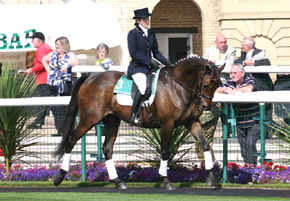 |
BOMBIE'S temperament is quite complex. He is gentle and very sensitive so can soon become quite flustered plus he carries a lot of tension, yet he also very determined and tough so whilst his training is now proving to be very consistent, competition performance can still be a little up-and down! HERE he is parading at Doncaster - not looking too bad for a little chap who has had a catalogue of racing injuries and is not far off his 18th year! Age is need not be a barrier with the right training.
|
THERE are a considerable number of people who have a horse out of training and do not realise just how much their horse can change physically. |
"Indie's Rock "n" Roll"
SADLY Indie's career as a point to point horse was not a happy and successful one with him enduring several falls.
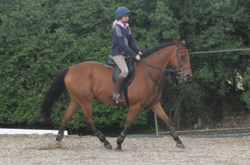
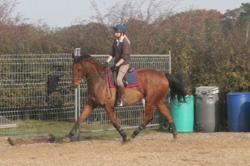
WHAT a difference a few weeks of correct training can make. Indie is transformed. In the first photograph he is rigid and not accepting the contact or the leg. However in the second we have a forward going horse that is altogether more active and now a joy to ride.
"Call Oscar"
OSCAR is our current "project horse" - a replacement for the wonderful little "Blue" who sadly had to be euthansed just three months into our project with him. OSCAR suffered a tendon injury which interrrupted what was looking to be a promising career with 2 wins and several placings under his belt. . He achieved a very creditable 2nd on his return to the track but sadly his next run saw him fall. Subsequently he suffered another injury whe working on the galllops and it was decided to retire him from racing. THIS photograph was taken the day Oscar arrived. |
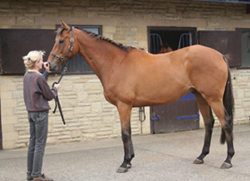
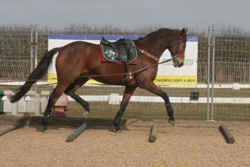
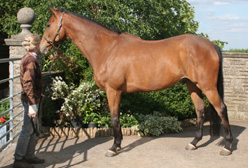
LOOKING at the photographs below, we can safely say that Oscar is shaping up well
 |
 |
CALL OSCAR can be seen in occasional features in "Your Horse" on racehorse retraining.
STOP PRESS
For those of you seeking to buy, sell, loan or home an ex-racehorse, then check
www.sourceanexracehorse.co.uk
STOP PRESS
Re-Educating Racehorses - A Life after racing by Fred Cook and Rowena Simmonds: Book Details
FURTHER READING
Magazine Features on Re-educating the Racehorse by Equine Management and Training
Rehabilitation and Retraining of Racehorses
(256k Adobe Acrobat PDF file)
Reproduced by kind permission of "Equestrian Life"
Follow the retraining of "Blue"
Follow the retraining of "Blue" 2
Reproduced by kind permission of "Your Horse"
On the Right Lines - from YourHorse.co.uk
Reproduced by kind permission of "Your Horse"
Horsescene - Retraining Race Horses part 1
Horsescene - Retraining Race Horses part 2
Reproduced by kind permission of Horsescene magazine.
Retraining of Racehorses - Charities
THE R.O.R is the charity responsible for funding the Moorcroft Centre, Greatwood, TRC and HEROES through money raised from the BHA, Levy Board, the Tote etc to help raise awareness regarding the necessary care, attention and retraining ex-racehorses require once out of training.
|
WE are Retraining Consultants to the RoR, are on the R.O.R. "Ask the Experts" panel and run the Helpline. FOR more information about the ROR please visit their website. |

|
THE idea of HEROS (Homing Ex-Racehorses Organisation Scheme) began to take shape in the early 1990s, when owners and trainers asked Grace to re-home their racehorses. A large network of clients has now been built up and many other people contact HEROS daily, as the word spreads. With a lifetime’s experience of horses, knowledge and experience of racing, plus a range of excellent contacts, Grace knew there was scope to give these horses a second chance – with a new career. There are many opportunities for them such as eventing, dressage, polo, show-jumping, hacks, companions and more. HEROS was granted charitable status in July 2006 with help from the RoR. ROR (Retraining of Racehorses), British Horseracing's official charity for the welfare of former racehorses. |