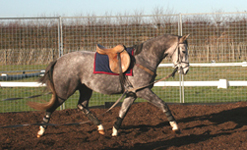
GROUND TRAINING
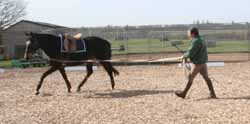
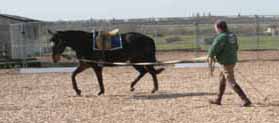
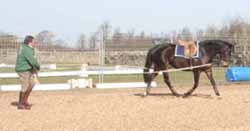
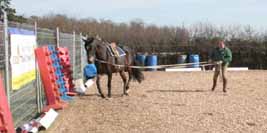
GROUND training is what it says - training from the ground. Thus is encompasses a huge range of activities and skills from both horse and trainer. In its earliest and simplest form ground training commences with all the initial handling that a foal receives and then throughout its adolescent and adult life; in its most advanced form ground training is teaching Grand Prix dressage horses their 'high school' moves.
BELOW we have set out the basic elements incorporated into our ground training programmes.
THERE is is no such thing as a short cut in the world of proper horse training! Training is all about time - working consistently to produce the required mental and physical development of the horse.
We will not be governed by set time constraints; horses can come for an assessment period
after which a suitable programme can be determined.
Ground Manners and Ground Control
A HORSE should be sociable, polite and respectful whilst of course retaining his character and individuality, otherwise the most simple of tasks becomes difficult and when training proper begins there is little or no foundation on which to build. So it is important that certain ground rules and boundaries are put in place. This is not done by way of domination but by letting a horse learn which behavioural options are the most comfortable to live with; a horse should be encouraged to follow the right path with correct, positive and confident direction from his trainer.
TRAINING or teaching really commences the day baby is born but we constantly have horses here that lack basic courtesy and social skills (Ground Manners) both in the stable and the field they will not tie up happily, they snatch their feet when asked to pick them up, they do not lead well, they will not stand still, they cannot manoeuvre around a handler, and so the list goes on. These basic skills need to be in place and the horse confident in their execution before the real work can begin.
AN ill-mannered horse has the potential to be a dangerous one. It is is vitally important that a horse responds to what is asked of it as there may be a fire or some other hazard and his obedience and co-operation are vital it could be the saving of his life!

|
STALLIONS in particular need to have good ground control manners in place as a matter of safety not only for themselves but for those around them too as they can readily become a bit headstrong when the testosterone kicks in!
THIS 3 year old Warmblood Stallion has learnt that being tied in the stable is nothing to worry about. He soon learnt that whatever fuss he created, no-one was going to untie him,
so the sooner he stood quietly the sooner
he would be let down. |
WORKING with a horse to put the basics in place (or reinforcing them if the horse already is familiar with such requirements) enables the horse and us to become better acquainted and for the horse to build his trust and confidence in us, to realise that we are no threat and mean no harm. This we do by teaching horses to respond to cues from our body language and steps as well as working with the natural lines of influence and energy contained in the human and equine body.
|
ESTABLISHING what we call Ground Control and Ground Manners teaches horses to give us their full attention, respond to the cues given, be respectful, builds their confidence, establishes us as the one to follow and is the foundation upon which further training is based.
THE filly pictured here with Fred is giving him her full attention.
|
|
HOWEVER basic or simple some ground exercises appear to be, for the young horse they require a lot of concentration so we keep "working" periods short to begin with. Also,
young horses tire very quickly.
DURING training sessions we constantly reward and reassure horses, whatever their age
(remember ground training is not just
the preserve of the young horse; often
the older horse needs reminding of his
manners.
THE filly has responded to the cue to walk to Fred and he is rewarding and praising her accordingly.
|
ONCE basic ground control and manners are in place the progression to other stages of training follow much more easily.
Loosework
WORKING a horse loose is an invaluable aspect of ground training as the horse works independently taking his directional cues for direction, pace, etc. from voice, body language and step cues from the trainer. It is important that the horse has already completed some basic ground control training so that he is comfortable and familiar with the directional cues given but most importantly is not confused or stressed by being asked to do something he does not fully understand. Loosework builds so much confidence in any horse as he is working all by himself) or at least he thinks he is!).
OBVIOUSLY in the early lessons a horse cannot be expected to act immediately to the directional cues given until he has been guided into making the correct responses as with all training it is a gradual journey, but with the more loosework that is undertaken the better the horse becomes at reacting to the subtlest of cues given.
INDIE shows his way of going when left to his own devices.
HE pokes his nose and props himself using the underside of neck muscles. His neck has no muscle tone and is shapeless. There is nothing happening behind the saddle - no impulsion, no activity of the hind leg - as Indie is not using his muscles.
USING himself, or rather not using himself, in this way, this horse will never develop the right muscles not only to support himself properly, but also carry a rider. |
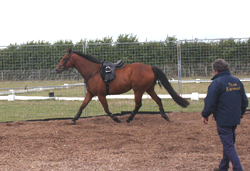 |
INITIALLY having assessed Indie we elected to use side reins and observe the reaction from him.
SIDE REINS should be used with extreme care as it is very easy to fit them incorrectly and force the horse into a fixed outline rather than encouraging the horse to seek the desired outline. The horse should also be kept moving actively forward.
INDIE responded well - and as can be seen - the side reins are not pulling his head in. They are merely indicating to him that it is more comfortable to drop him head thereby rounding and lifting his back muscles and so generally making working actually more comfortable.
INDIE looks a completely different horse already. |
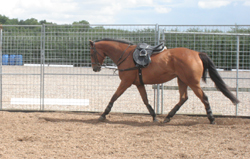 |
OF COURSE a horse can also work loose with tack on. This is excellent for young horses to fully accept the saddle and a bit prior to the next training stages.
PLEASE NOTE: WE DO NOT ADVOCATE THE USE OF SIDE REINS AS A MATTER OF COURSE.
We use our discretion following assessment of the individual and the timescale we are working with in order to progress training or resolve training issues to the maximum benefit of horse and rider in the time we have to work with.
Side reins are not used with young horses that are unfamiliar with a bit in their mouths as the risk of damaging delicate mouth tissue is just too great. Side reins can be useful when re-educating the horse out of training to encourage a lowered headcarriage and accept a contact but, again - discretion is the key. Much harm can be done by ill-fitting and/or inappropriately used side reins on any horse!
Lungeing
WORK on the lunge contradicts much of the what we initially teach the young horse regarding ground manners and control as the exercise not only 'sends it away' but also the horse loses guidance from our step cues as he is required to work around us instead of using our body motion as his instruction as to what direction to go in and at what speed. Consequently we introduce lunge work when a horse is totally at ease and responsive to basic ground control cues.
CONSTANTLY winding a horse around on the lunge line not only places undue strain on the unfit or unbalanced horse, but done incorrectly it is all too easy for muscles to be built up and set in the wrong places. Â How many times do you see horses flying around on the end of a lunge line, often cantering disunited with their helds up in the air - what good is that doing? A horse needs to be responsive to the aids and cues from the trainer in order for lunge work to be effective.Â
HOWEVER, correct and efficiently executed lunge work does have benefits in that a horse can be encouraged to go forwards with impulsion, rhythm and pace can be established and balance and co-ordination can be improved.

|
WITH young horses or those that need specialist rehabilitative or schooliong work, we "walk lunge" i.e work in an oval rather than a circle, until such time as the horse is settled, confident and more balanced within its movement.
THIS provides an excellent opportunity to teach the horse directional cues which will be invaluable during later work.
|
|
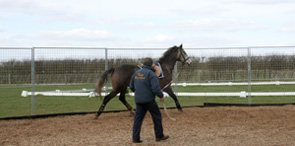
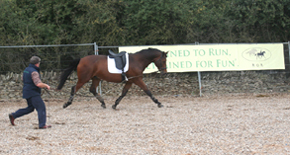
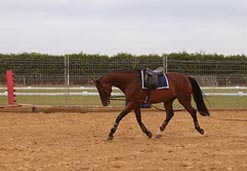
WATCHING this horse on the lunge tells us much about him.
ALTHOUGH he is moving actively, there is a complete rigidity to his neck; it is lifted from the withers instead of flexing from the withers.
HE is not seeking a contact - and indeed will not as without direct intervention from the trainer
he will continue to trot around quite happily but not learning anything nor achieving any suppling. |
THE answer in this case is long rein the horse so that he can be encouraged forwards into the contact which will in turn have the effect of correcting the headcarriage.
THIS Donnerhall/Negro gelding is showing all the signs that the excellent breeding of his parentage jas been passed on.
UPON arrival he was very gangly with a rather thin neck. He naturally carried his head very high to the point where muscle would soon have started to build underneath his neck instead of along the topline if careful encouragement to drop his head when working was not introduced. |
|
THE outline the gelding nows presents is absolutely fine allowing correct muscle development all over his body but without being forced into an unnatural, uncomfortable position.
PLEASE NOTE: Side reins are being used here - for the reasons as described above - but they are not attached to the bit. Unfortunately the picture quality is not sufficient to show the training cavesson we use so that young or very sensitive horses are not worked off the mouth.
Introducing Saddlery
PUTTING a bridle on the young horse for the first time should not present any problems so long as the exercise is carried out quietly and patiently plus of course he must be allowed time to adjust to the feel of this strange "contraption" before being expected to carry out any form of training exercise. However bridling difficulties do manifest from rough and insensitive handling of the young horse.
THE introduction of a roller and then the saddle is where difficulties can arise as the young horse will often object to something being fastened around him; his instinct is to rid himself of what he sees as threat to his safety but of course he is only reacting to what his natural instincts are telling him.

|
THIS 3 year old Stallion has been well handled and is accustomed to rugs so the introduction of the saddle has not really caused him any problems; he is just having a bit of a play and showing some natural exhuberance.
PLEASE note that the lunge line is not attached directly to the bit.
WE do not like the traditional lunging cavesson so opt for a training cavesson produced in Germany.
|
THE role of the trainer is very important at this stage as there must be no restraint merely encouragement for forward movement. The experience for the young horse must not be turned into a negative one by having someone pulling him about, shouting at him or chasing him with a whip.
THROUGHOUT their lives some horses will always "bend their backs" a bit if they have not had a saddle on for a while although it is important to rule out other contributory factors.
Long Reining
IN our opinion a horse cannot be taught and trained properly without being long-reined. Yes, it is one of the so-called traditional methods of working a horse but there really is no other training method by which horses can be taught so much, everything in fact, and indeed it is the only way to 'make a mouth'. It is nothing to be wary of in terms of being overtly bossy or dominant over a horse - the same 'rules' of mutual trust, understanding, co-operation and communication apply as with all aspects of training. Sadly though, it is an increasingly neglected part of the training and development of the young horse as it is considered by some to be 'old fashioned' but possibly the truth of the matter is that many people get into difficulties with long reining because they really do not have the appropriate skill to undertake it properly. Long reining is far more than just walking behind a horse with the reins in loops especially if the horse is to be taught proper rein contact, lateral movements, hock engagement, piaffe and so on.
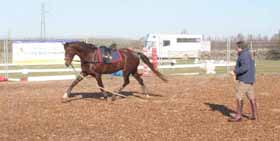
THIS mare is rising 4 years of age and is having her first long reining lesson.
BETH is a little mare that is very quick to learn and with horses like this it is very easy to be tempted to push on too far too quickly. Within just two days young Beth was responding far better than most horses of her age and even got to grip with gentle sideways movement.
IT IS important throughout all the stages of a horse's training, to take its breed, physical development and mental capacity into account. Mare, gelding or stallion is also a consideration.
WORKING a horse on long lines is an excellent way to 'observe'; to the trained eye much can be assessed and signs of potential resistances can be detected early on, as can any unsoundnesses. Most corrective training is carried out from the ground as is work towards more advanced dressage movements as the horse can be educated without the hindrance of a rider.
| HERE is the grey horse that is featured above.
UNFORTUNATELY during his early re- training work the horse was over active inthe mouth to the point of drawing his tongue back and then over the bit so for a couple of weeks we did use a flash noseband (combined with a bit change)..
WITH lines around him, there is now more control over what his body is doing thus he can be guided and encouraged to start using the muscles he has forgotten about - or rather resisted using!
|
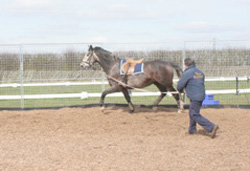 |
| THE resistance had primarily set in due to an incorrect saddle fit for this horse. Although this had been resolved - plus associated remedial chiropractic work effected - prior to the horse's arrival to us, there remained the psychological factor that the saddle equated to discomfort. He had set himself to minimise his discomfort and this was now a habit which had to be broken.
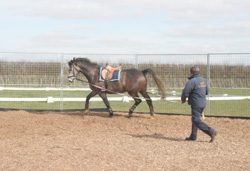
THE horse's stride pattern has shortened a little whilst he gets to grips with the idea of being able to drop into the contact and still go forwards at the same time. |
 |
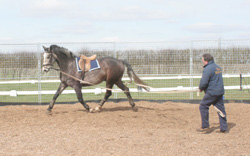
MUCH better!
ALTHOUGH the head carriage is still a little high
for the stage of training, the horse is now moving actively into the contact.
A CONTINUATION of this type of work will see the neck lower more so that the muscles of the back are stretched and strengthene. The muscles of the hind quarters will develop more so that eventually the horse looks more like one horse rather than 2 joined together. |
 |
LOOKING at the photographs it is always important to bear in mind the different breed characteristics of the various horses.

|
THIS wonderful horse (all 18.2hh of him) was extremely green, lacking the appropriate physical development for his size and age when he arrived with us. He was very stiff, taut and tense throughout his body. The photograph shows "Jazz" after a few weeks of loosework which encouraged him to stretch out and elongate his body. More muscle is still needed behind the saddle, but this is where long reining comes in.
WE do not confine long reining work to the manege all horses are also worked in the open as it is important that they learn to keep their attention focused despite the presence of distractions.
|

|
AFTER a few weeks of long reining work, including polework, (combined with loosework) Jazz has shown significant improvement and there is quite a change in his appearance.
NOT ONLY is Jazz clearly more athletic and supple but he has the physique to match his size. A suppled acquires a completely different way mof moving - there is more elevation to his paces.
FURTHER pictures of "Jazz" can be seen in the Polework and Loose Jumping sections. |
LONG REINING is also an exercise of the mind as the horse has to concentrate in just the same way as he does when ridden and that is why it plays such an important role in the re-schooling of horses that have become soured, nappy and so on. Hence long reining is not just for the young horse - it is an integral part of the training of all horses, irrespective of their age and physical development. Please also refer to the "Retraining of Racehorses" section.
AS with riding, the trainer needs a wonderfully soft, giving hand and this is why long reining is such an art that so few people can execute.
|
HOW long reins are positioned is of great importance. It all depends on the individual horse and what his training programme requires. As in all aspects of a horse's management and training due regard should be paid to his needs - he must not be pigeon-holed
THIS horse has an incredibly soft mouth amd has shied away from seeking a contact. Fred has the lightest touch on the lines so as not to create any restriction on the horse's free, forward movement.
|
AS aforesaid long reining is not just a tool for the training of the young or older horse or part of the re-training for horses off the track; it is the most effective way of correcting from the ground bad habits, improving balance and outline (building muscle, etc.) and suppling.

|
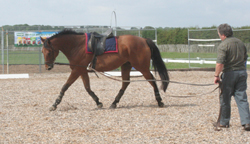
THIS horse was distinctly overbent. As can be seen from the photograph even with no contact on the lines he has dropped at both the withers and poll.
THERE is a difference between a horse being deep and round (not to be confused with Rolkur) and overbent.
WHILST dropping and stretching during and at the end of schooling sessions is to be encouraged as much as possible, this horse is clearly "curling in"; although the hind legs are stepping under well the fore legs, given the size of the horse, are not covering any ground. |
|
WITH correct guidance the horse has now opened through the neck considerably; his croup has lowered a little and the hind legs are still active.
THE horse has now adopted a lovely lowered, rounded outline which will work and lift the back muscles and so help engagement and stretching of the hamstrings.
Such an outline also encourages relaxtion between more collected exercises.
HE is still a little short in front (tight through the shoulders) but further training, including work over poles, will resolve this.
|
WHEN training a horse his breed type must be borne in mind. For example, frieisians are upright in front and are generally short-coupled so care must be taken not to shorten them up even more!
JUST as with the ridden horse when the rider should be able to place the head/neck exactly where he wants its (obviously when the horse is suitably schooled to understand the aids), so with the horse on long reins.
HERE Fred is working with Indie, who has to work hard to compensate for his bowed hind leg. Whilst Indie is presenting a good picture, he is actually overly exerting himself! Whilst he is not going to gain paces to equate with the horse above, a little more "lift" can be achieved. |
|
FRED has now asked Indie to work deeper and rounder (not to be confused with the "drawn in" effect of the horse in the two photographs above these).
SOME horses do benefit from being asked to work in a deeper, rounder outline as part of therir training programe as it helps them loosen and engage better.
THIS type of exercise can be followed through to ridden work.
|
|
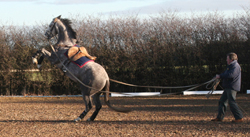
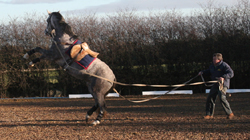
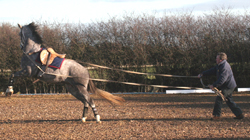
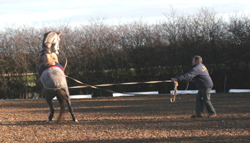
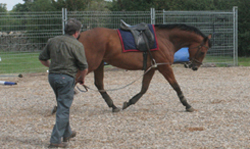
OF COURSE not every horse behaves perfectly all the time; some can be quite demonstrative. As trainers it is our task to establish why a horse acts and behaves as he does - is it just playfulness and exuberance, is he misunderstanding what is being asked of him, is he feeling some discomfort or, is he being "naughty".
HERE is a sequence of photographs illustrating the importance of a person very skilled in long reining being at the end of the reins! Such behaviour is of course not acceptable and has to be eliminated before a horse is backed as he must not get the idea he can do this with a rider!!
LONG REINING is invaluable for the older horse, helping to keep him soft and supple.
SUCH exercise also provides a good work out for dressage horses to observe how they are moving and check that all important headcarriage without the weight of a rider.
ALSO all the advanced movements can be taught prior to the horse having to support a rider.
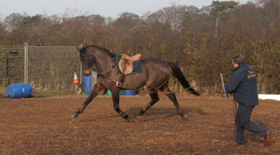
HERE Mr. Bojangles, one of the most successful ex-racehorses in dressage (reaching Advanced Medium), shows that medium trot is not just the preserve of the warmblood! |
|
Pole Work
WE spend a considerable amount of time working horses over poles on long lines. It is a very beneficial exercise which encourages joint flexion and stride extension, helps establish balance and co-ordination and also aids concentration thus providing valuable training for horses in all equestrian spheres. The exercises can be varied so much that training can be kept interesting and stimulating for the horse; boredom must never be allowed to creep in. For horses that are particulary responsive to the trainer's cues, polework can be executed as part of loosework.
WORK over ground poles can be done in 'collection' or in 'stretch' - both exercises are of equal important so are incorporated into our working programmes - and, as with long reining, is of benefit to all horses.
 |
THE horse in this photograph is performing what is asked of him.
HOWEVERhis work lacks expression and activity; he is doing what we call "going through the motions"; butat least the poles are having the desired effect - that of increasing shoulder movement.
MOST importantly the horse is clearly relaxed and happy with what is being asked of him.
|

|
HAVING performed the exercise a few more times there is now more expression from the horse - there is spring to his stride and he is altogether more focused..
WITH increased suppleness and confident in himself as the schooling session has progressed, the horse now maintains a better headcarriage as he is working through more from behind.
|

|
NOW greater elevation to the stride has been achieved and more activity through the hock but this at the expense of losing the outline and expression.
HOWEVER as the horse becomes more confident and experienced in these sorts of exercises he will be able to "bring everything together" but for now he is performing well and is not stressed in any way - he makes for a happy picture.
|
AS a horse progresses in his training, future training sessions can see the introduction of raised poles to increase suppleness, co-ordination and engagement.

|
AGAIN, this photograph of Fred working "Oscar" illustrates how a horse can do as he is asked but in a "just going through the motions" kind of way.
WHILST many people would be pleased with this performance, there is much to be desired as far as we are concerned.! The horse is not doing anything wrong, he just is not putting any "energy" into the job in hand.
COMPARE this photograph with the one below.
|

|
THIS photo taken a few minutes after the one above.
"OSCAR" is now thinking much more about the job in hand and is responding to the cues given.
CONSEQUENTLY "Oscar" is much more active and engaged over the poles. This training session is now of real benefit rather than just being a bit of exercise!
HORSES can be very clever at fooling their trainer into thinking that they are working whenin fact they are doing the bare minimum! |

|
AS flexion and suppleness improve the nature of the exercises can be altered to take account of this in order to continue physical development and work towards full hock engagement. "Oscar" has now been asked to negotiate raised poles.
ALTHOUGH he is working actively and uniformly through the leg he is trying to ease himself over to the lower end of the pole (because it is easier to negotiate) as evidenced by the setting of the upper neck muscles. |
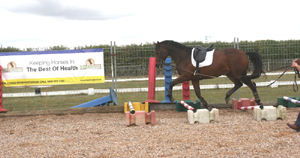
WORKING a horse over raised poles is absolutely invaluable for all manner of reasons. Apart from increasing/improving athleticism generally and improving joint flexion, such work also adds great variety to what could readily develop into a boring exercise.
EXERCISES over raised poles also helps rehabilitation after pelvic injuries and to strengthen weakened ligaments around the stifle joints (usually the cause behind a locking patella).
|
 |
AS with all training, a horse needs to work in a relaxed and rhythmic way, and proof of this is his breathing; when a horse does not breathe he is tense, when he is tense, he is not learning.
A HORSE must be relaxed and at ease both at the commencement and end of his training sessions. Â If a horse is tense before he even starts his work, then that he is not going to respond well during his lessons. Equally so, a horse that does not end a training session in a relaxed state of mind may not be so willing to want to work the next day - and that is when impolite behaviour may begin to show up!
In Conclusion
UNFORTUNATELY not everyone has the aptitude, patience, knowledge and understanding to work with their horses in this way and that is why there are so many horses in the world that are unhappy and distressed, resulting in misbehaviour and the development of behavioural abnormalities. The knowledge of this concerns us greatly as horses are such magnificent animals deserving of our love, respect, trust and understanding.

|
FROM reading the above it can be seen that we train horses in a way they can relate to, in a sympathetic manner, with patience and complete understanding of the equine psyche - what is termed today as 'natural horsemanship' - but it is not a new phenomenon; it is just that training in this way has been lost by so many over the years in order to get horses to be "obedient" and "submissive" - terms you will not hear in our training vocabularly. |
|