FOR the significant number of riders in the UK, owning a horse is a leisure activity,regardless ofwhether they elect to compete or not. Consequently the horse-owning experience is meant to be an enjoyable one - and ideally for both horse and owner. The relationship should be a happy one comprising trust, harmony and happiness.
HOWEVER this is not always the case and things can and do go wrong with practical difficulties manifesting. Although the cause is not always immediately evident, it is usually due to a breakdown in communication between horse and rider with each not understanding what the other requires and inconsistency in method on the part of the rider often coupled with a lack of attention to signals given out by their horse not being recognised and acted upo
THERE are so many books and videos/DVDs available these days and of course access to training clinics and demonstrations to provide help and inspiration. But thist does not suddenly provide someone with the necessary skills to carry out effect training or mean that miraculously the horse will suddenly understand..
IT may be simply that a person is not sufficiently experienced to train a young horse, is unsure how to deal with certain behavioural manifestations or lacks suitable skills in the saddle; perhaps it is a case of not wishing to be involved with certain aspects of training or suitable facilities are not to hand. Whatever the situation, however inexperienced or experienced someone considers themselves to be, everyone needs assistance at some time or other, so no-one should ever be afraid to seek help and advice. The sooner the slightest indications of change are acted upon, the easier the "problem" is resolve for both owner, trainer and horse.
 |
|
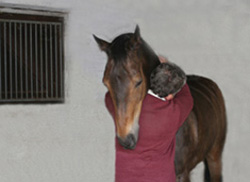
WE believe that at the base of successful training lies the absolute necessity to have the ability to relate to a horse, to form a bond with him, so that he is at ease and relaxed. From this sound and solid foundation a successful 'working relationship' can be built. This menas that training is not just about what happens outside of the stable or field; it comprises the bigger picture of every aspect of a horse's life.
ONE of the important factors in our training is to spend ' time with the horses in our care with a horse over and above that taken up by training or routine management so thatwe can really get to know each other and the horse does not continually see us either as a food source or the "nasty person" that comes along and makes him work!
THIS not only helps maintain a relaxed state of mind but also is an invaluable part of the developing relationship required for a successful training partnership and of course is a major part of working with behavioural and anti-social issues.
|
 |
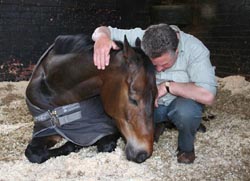
BEING able to interact with a horse that is laying down is a testament to the amount of trust a horse has in a person as the horse on the ground is very vulnerable and his instinct tells him that he should get to his feet the moment someone or something comes into his space.
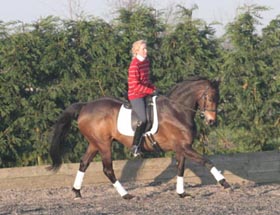 |
HOW can a horse be expected to give
of its best or learn properly if
there are causes of stress, etc.
in his home life?
IT IS an owner's absolute duty is to ensure
the daily physical and pschologcal
welfare of their horse. This applies whether the horse is stabled or lives out 24/7.
A HORSE is totally reliant on his owner for all of his needs - from basic care and management throughto the emotional comfort he requires such as compansionship.
PLEASE refer to the "Management" section for further information. |
We are here to help you get the very best from your horse through correct management and training but most importantly by working in a language that he understands and can relate to. |
Horsemanship/Equine Psychology
THERE is a misconcept that all approaches to training are cruel and forceful unless they come under the head of "Natural Horsemanship". Throughout history, and indeed today, there are many horsemen who have worked with their horses not against them. Native peoples from around the world are perhaps the best trainers of all as they have a great reverance and respect for all living things. The so-called modern techniques of training horses which are much promoted at present and termed 'natural horsemanship', etc. are not new - they have been practised for many, many generations. Today, it is just the case that at long last more trainers and owners have come to realise the importance of understanding equus.
NATURAL HORSEMANSHIP is a term that is that is part of everyday equestrian language these days but what is really meant by this term? It is wide open to individual interpretation and there seems to be much diversity between those who allegedly practice it so we are very wary about some who proclaim to train in this way. And of course much of what is advocated by "NH" Practitioners is just not realistically practicable particularly for the competition horse but this does not mean its welfare is compromised or that it is not a happy horse.
THE statement that "a horse should be treated as an individual" is readily quoted but how many people really do act on this statement? Ok, so whilst many more people do accept nowadays the important of feeding the individual, how many of those people then address other aspects of management and training. Every horse must be treated accordingly to his own unique psychological make-up. For example, some horse are happy turned out in a group, others prefer just a single companion, whilst some actually prefer to be on their own (provided they are not isolated from visual contact with either other animals or people). How many people adjust their training techniques from horse to horse? Just because one method worked with one horse does not automatically mean that is the best way for another.
|
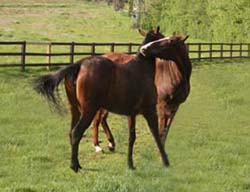
BY studying horses interacting with each other a great deal can be learned as to how they "think", how they communicate with each other in their natural environment (the wild) and live together as a herd. This better understanding enables training to be far more successful and rewarding and a whole lot more beneficial to the horse as he is more relaxed and attentive as you are communicating in a language he understands - "equi-speak".
EVERYONE who carries the responsibility of a horse's education should have a basic understanding of herd life and the behavioural and language that exists between horses. |
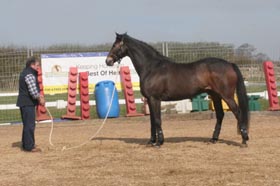
SUCCESSFUL training is not achieved by bullying, force or absolute dominance. The relationship between horse/trainer or horse/rider is a partnership based on trust and understanding. The lines of communication must be opened and remain open at all times; the trainer must be attentive and be able to 'read' the horse he is working with, anticipate its reactions, know when to ask it to 'give' a little more and when it cannot absorb any more on a particular occasion; this is the secret of successful training and horsemanship.
WHATEVER the training being undertaken, a horse should not be frightened into doing anything; it must be allowed to work and develop at its own pace.
TRAINING should be a positive experience, not a negative one with the trainer literally controlling every move the horse makes, this being achieved by taking control of the mind - we want respect from a horse but not via rough, brash or noisy behaviour and gesticulations.
OF
COURSE some horses are much
more challenging and require firm
handling but this does not mean
inflicting fear or pain. |
|
THE behaviour a horse exhibits during its training, whether a youngster or an older horse, is a vital indication of its attitude and understanding of what it is being asked to do; aggression, resistance, napping, and so on are all signs that trainers should acknowledge and act upon. Such behaviour is usually because the horse is confused, is not physically capable of executing what it is being asked to do or it does not understand what it is being asked to do. Horses can soon develop bad habits but in the majority of cases it is through poor handling, training and riding. Naughtiness however must not be confused with high spirits, playfulness and good physical well-being; take advantage of this and direct the exuberance into an enthusiastic worker.
HORSES should be content in their environment at all times and if not, steps should be taken immediately to correct the situation.
IT is automaticaly assumed that a horse will always be content within its grazing environment whether turned out for a couple of hours during the day, all day or all the time, but this is not always the case and the individual should be closely observed for signs of stress.
THERE is absolutely
no reason why a horse should not be content within a stabled environment but this of course is dependent upon how successfully his physical and mental needs are addressed.
PLEASE read the 'Management' section for more information on this subject and also refer to articles posted in Horsetalk, in particular "The Environment in which we keep horses".
|
 |
THE TRAINING of any horse should not to be undertaken by the inexperienced, but especially the young horse just starting out, but unfortunately this is where so many people go wrong; they have the idea of breaking their own youngster but sadly all too often, things go terribly wrong. It takes considerable time and patience to train a horse but he does not ever forget the basics of what he is taught, even if he does become a little 'rusty'; what and how he is taught remains with him throughout his life, so it is our responsibility to give each horse the best possible training.
OF COURSE many people are understandably wary of sending their horses away from home for training. This is not just because they have heard unpleasant stories about inappropriate treatment and training but they are also concerned that their horse may lose its character or that it will stress too much. Our training encourages the development of the individual character; we work with that character not against it. And we have not had a horse yet that has not settled in within 24 hours. A look at all the photographs within this website will show horses that are happy and content.
WE owe the horse a tremendous debt of gratitude.
JUST think how many horses have given their lives or suffered hideous injuries in the course of all the wars. Man has treated this most loyal of servants dreadfully; it was a compansionate soldier that put his horse out of its misery on the battlefield rather than leaving it to die in agony.
HORSES have also been the providers of food - and man cannot always ensure that has been/is achieved in a stressfree, painfree manner. And over the centuries and indeed today, horses (as with so many animals) are continually exploited in some countries in the name of sport; it is not only the bulls that suffer in the bullring! |
|
SO is it not the least we can do to ensure that our horses are managed and trained in a humane and sympathetic way? Is that too much to ask for our faithful friends?
In Conclusion
HAVING had many years of experience handling and training a wide range of horses from all equestrian spheres, we have built up a training system which connects with the natural instincts a horse has. By drawing on that wealth of experience and knowledge we produce horses that are forward-going, polite and well-mannered, but above all are confident, happy and full of character and personality because we understand their psyche, their rules, their language.
WHATEVER YOUR TRAINING REQUIREMENTS, PLEASE CONTACT US FOR FURTHER INFORMATION
|
