MANAGEMENT |
Management Requirements
WHETHER a horse is primarily stabled, grass kept or a mixture of both, its correct management is essential. The welfare of a horse is of primary importance and takes priority over any training or behavioural issues, but unfortunately mangement requirements are not always given the attention that is warranted.
ALL TOO often we see how inappropriate, incorrect or even poor management impacts upon a horse's behaviour. It's quite simple - how can a horse be expected to perform what is asked of him if, for example, his physical and/or mental welfare is not being addressed and he is denied the very basics of what his natural comforts should be? A horse's mangement programme is a vitally important and integral part of his training, the two go together.
WHILST it is commonly accepted that when a person is not eating or sleeping well, has an ache or pain somewhere or is just not feeling quite 100%, then this impacts on their behaviour and ability to carry out their job of work; a horse is no different. In an alarmingly short period of time behavioural problems can develop - not just so-called "stable vices" such as weaving, box-walking, etc. but also anti-social and aggressive attitudes. Then as times passes the unhappy or stressed horse has to "shout" a bit louder for his voice to be heard if his physical, psychological and/or physiological needs are being ignored.
|
THE power of observation is a very powerful tool which is available to everyone. Any change in behaviour, however small, should be noted as this could be a sign of things to come whether as a handling, ridden or veterinary matter. HOW a horse reacts and responds during his rest and play time, ground training or ridden work is very important as this assists in determining the presence of any sort of physical ailment, physiological disorderor management issue which needs |

Attention to Physical Welfare - if your horse has any physical problem we will find it!
ENOUGH emphasis cannot be placed on ensuring that there are no physical problems that could give rise to misbehaviour (or so-called bad behaviour) before embarking on any form of training regardless of the horse's age. A young horse can just as easily have sore spots and tensions within its body as an older horse in need of further training work or re-schooling.
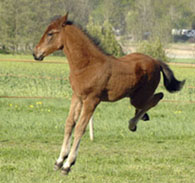
LETTING off steam is a wonderful tonic and prevents sourness and nappiness setting in. THIS little horse lives life to the absolute full. He not only works hard but he plays even harder!! |
|

THE only way horses can communicate any discomfort or unhappiness, whether of a physical or mental nature, is through their behaviour and the way they interact with us i.e. using their body language. We act upon this body language otherwise further distress will be caused which will lead to a worsening of the situation. So many times a horse's distress signals fall on deaf ears and blind eyes!
TO this end we make an assessment of all the contributory factors to ensure that a horse is in as physically good shape as can be expected, taking into account his age, type/breed, any known physical problems he may have had or is continuing to experience and the initial reasoning behind his stay with us.
Physical Welfare - The Musculo-skeletal Structure, Physiology
OFTEN horses that come to us exhibit incorrect or even abnormal muscle structure due to having been worked in an enforced outline (as opposed to just being overbent), particularly at a young age. Working a horse in this way can not only damage the muscles and create stresses and strains throughout the body (because the body as a whole is not correctly toned and aligned) but also can readily result in stress related conditions - all matters which have to be corrected before the real training or re-training work can be commenced. Also it may be that there has been an injury of some sort from which the horse has not either fully recovered or appropriate physiotherapy has not been carried out to tone and strength weakened muscles, tendons and ligaments..
WE can readily pinpoint sources of discomfort, recognise incorrect gain movement, idiopathic lameness, muscle tension and deformity, etc. so when deemed necessary (with veterinary approval) appropriately qualified practitioners are called upon to help us resolve such issues. Of course if at any time we consider veterinary intervention is required (or at an owner's request) then we call upon the excellent services and facilities offered by the team at Fellowes Farm Equine Clinic.
|
GEORGINA SIM has the responsibility of attending to chiropractic matters for us. |
HELEN MORRELL is a Veterinary Imaging Thermographer and provides an extremely useful service to the yard. |

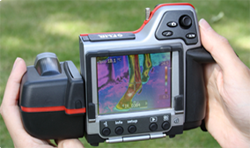
HORSES that have been under mental or physical stress for whatever reason usually display signs of physiological disorders albeit they are often very subtle and so usually go unnoticed by even the most diligent of owners. However we can readily address these once we have had the chance to fully assess each horse.
WE use a variety of treatments to correct any issues which manifest combined with lymphatic drainage, massage, suppling and stretching exercises, alongside tailored schooling exercises.
HELEN MORRELL is a Veterinary Imaging Thermographer and she provides an extremely useful service to the yard.
VETERINARY thermal imaging can detect subtle changes within strucutres of the body up to three weeks before a physical sign of damage becomes evident.
HENCE for the horse that is performing or responding to training as he shoujld, VTI allows us to take a look what is going on and decide whether chiropractor, physiotherpaist, dental technician, saddle fitter or vet is required.
|
OUR Equissage is an absolutely invaluable piece of equipment and we would not be without it - or rather them - we have 2. |

WE do not favour the use of chemically based products and avoid them where ever possible preferring instead herbal and homeopathic treatments as they do not upset the horse's delicately balanced digestive system. Obviously we will only use proven products that are truly effective hence our reasoning for using herbal products that are either manufactured in the UK or imported from New Zealand and endorsed as being non-GM and of course are approved by the FEI and Jockey Club. We will be pleased to discuss these products in more detail.
Physical Welfare - Teeth
ANY pain or discomfort in the mouth is one of the main causes of napping, rearing, inability to come down onto the bit, etc, whether it be through sharp edges, incorrect alignment of teeth (and/or jaw) or something a bit more complex such as TMJ related issues.
OF COURSE problems within the mouth also result in a horse not eating properly and so contribute to various health issues.
|
|

Physical Welfare - The Foot
FOOT problems can simply be caused by unlevelness of the hoof from poor trimming, lack of regular maintenance or of course through uneven wear and tear. Shoes that do not fit incorrectly can pinch or contribute towards corns as well as placing stress on the fetlock joints. Sometimes it may be that some form of remedial shoeing is required to correct a minor conformation defect such as a twisting joint. Hoof imbalance can also be the cause of back pain as well as lowe limb lameness.
NICK FORRYAN trained with Martin Deacon, one of the country’s best farriers in our opinion. Nick, like Tom, is very patient and understanding especially with our nervous or fractious inmates. MANY of the horses we ask Nick attend to arrive with feet that are not always in the best of condition; whilst we prefer to keep horses unshod sometimes remedial shoeing may be necessary to correct imbalances etc. |
|

Physical Welfare - Feeding
THERE is a huge range of feedstuffs on the market these days and it can be very confusing, but we believe in keeping feeding simple, following as much as possible the pattern nature intended thus preferring traditional feedstuffs over compound mixes and ensuring that all feeds are pure, of good quality, non-GM and are strictly vegetarian.
IN the wild horses are constantly on the move, trickle feeding for up to 16 hours each day. They are forage (grasses) feeders with a digestive tract evolved to readily cope with fibre. Fibre is broken down very slowly in the hind gut so the consequential energy produced is released slowly. With this in mind, it is little wonder so many horses behave in an undesirable manner or suffer from digestive disturbances (eg: colic, loose droppings, etc ) when their diet is packed with high levels of starch!
HORSES have differing nutritional requirements throughout their lives. This is not just as a consequence of growing and developing from babyhood through to maturity and then into their veteran years, but also the amount and type of work they are doing has to be taken into consideration. The physiological make-up of the individual is also a major part of the nutritional equation. For example, two thoroughbred horses can be fed exactly the same diet, be kept under the same conditions and be doing the same amount of work, but they will not necessarily be carrying the same amount of bodyweight or have the same energy requirements.
|
|
YOUNG horses undergoing backing and ground training do not require "heating" foods; they need feeding for their growth and development. |
HOWEVER the horse that is in active work requires plenty of "fuel" to maintain his energy levels, condition and general health. |


A CORRECT and suitable feed programme is necessary for every horses which is tailored around its lifestyle. The old adage of "feed according to the work done" is still absolutely true. An unsuitable feeding regime for a particular horse can manifest in all sorts of behavioural problems, be the cause of poor performance or of poor physical condition. and whilst everyone is aware (or certainly ought to be) that adjustments should be made to take account of sudden changes in the exercise routine be that due to the weather, lameness and so on, how many people really consider the effect certain feed stuffs may have on temperament, take account of possible food allergies/intolerances, provide a feed that is of correct nutritional benefit for the individual and indeed, is actually appetising and enjoyable to eat? Too many horses are not only overfed but also incorrectly fed - your feeding regime may well be contributing to a lactic acid build up! Consider too that your horse may not actually enjoy what you are feeding him!
|
|


A HORSE can be underweight for a number of reasons. The horse above was suffering from several different issues when it arrived with us (left picture). With the correction of the issues put in hand, three months down the line, although there is still work to do, the horse presents a much happier scenario (right picture).
FOR the horse that has access to grass, grazing should not be relied up to provide all the nutrition that a horse requires; just because a field looks green does not necessarily mean that the grass is good. Also, for example, mares with foals at foot will require a pasture different to an older, laminitis-prone pony.
|
|
THESE two horses have very different needs - the mare is just 4 years old but is not in work as she is undergoing behavioural training; the gelding is 23 years old and has just retired - but both are pictures of health. |
THE mare with a foal at foot has completely different nutritional needs to the working horse; she has to supply vital nutrients to her offspring to not only guard against infection but also to ensure he develops properly. |


IT is important to keep grazing land in tip-top condition.
AND in order to achieve this it is important that grassland is rested, harrowed, rolled, sprayed, fertilised and topped; it is not just a case of a bit of re-seeding here and there to repair the damage done during the winter months. |
|

|
A Word about Worming
UNFORTUNATELY however diligent an owner is regarding their horse's worming programme, it is still possible for the horse to be carrying a worm burden. This is usually because of resistance by the worms to the product used but can also be due to the dosage being incorrect or the use of the wrong wormer at the wrong time of year.
IF we suspect any problems in this area then we have horses appropriately worm tested to establish exactly what treatment is required, taking account of the risk of post-worming colic if there is a heavy worm burden present. We will then advise on a future worming programme to prevent a recurrence of such situation. We have found a very effective herbal wormer - verified by worm counts - which sits nicely with a training style. (Please refer to the E.M.T. WORMING GUIDE for further help, advice and information regarding worming horses.)
Age Considerations
THE correct care and management of horses, irrespective of their age, is paramount to ensuring that a horse leads a happy life.
MOST people are aware that a horse's age should be taken into account regarding the amount of work he is asked to do; younger horses cannot be expected to work for as long or as hard as their older counterparts; the work-load of the older horse has to be carefully monitored to ensure that he is not putting undue stress on tired limbs and muscles. However many do not recognise and address the fact that as a horse matures and then enters his veteran years his nutritional requirements change.
OF COURSE this is another situation where it is so important to view each horse as an individual. Young horses mature at different rates just as older horses are affected by the symptoms of old age at different stages of their lives; some horses seem old at 15 years whilst others are as active at 20 as they were at 10 years.
Physical Welfare - Saddlery
SADDLERY which is incorrectly fitted or indeed, inappropriately used, is one of the most significant causes of poor performance, misbehaviour, sourness or just a generally unhappy demeanour. All items of saddlery must be comfortable for the horse and not interfere with its movement by way of restriction or constriction;and that includes such items as protective boots, stable and turnout rugs.
Saddles
A SADDLE that does not fit properly, apart from causing discomfort, also affects how a horse moves; in many instances it can prevent a horse being able to engage itself properly and be the reason behind head-carriage issues and the inability to move correctly. So by removing or eliminating back tenderness/pain and establishing that a saddle does not restrict movement we can progress our work happy in the knowledge that the horses are not impeded by their saddle.
THE conformation of the horse is also a very important issue as different breeds have such differing bone structures. For example, Friesian horses are very upright in front and have large scapulas which can make ensuring a good saddle fit quite hard whereas Cob types have well sprung ribs which can cause a saddle to "roll"; thoroughbreds invariably have "long withers" and a wider fit than initially anticipated is often required in order to ensure there is no pressure from the [stirrup] bars. And of course the saddle has to be the correct fit (and be comfortable) for the rider too otherwise its balance can be affected which in turn affects the horse's way of going.
WHILST the use of some form of saddle pad or numnah is good as an aid to general comfort especially for horses which tend to be quite sensitive over the back such as thoroughbreds, they should not be used to counteract the effects of an ill-fitting saddle; of course short term use if fine when a horse's weight alters, etc.
Bridles THE bridle itself also needs correct fitting to ensure maximum comfort especially around tender and delicate areas. A BRIDLE that fits too tightly can be the source of great discomfort; think how you feel if your riding hat fits a bit too snuggly, especially on a warm day!. |
|

Bits
EVERYONE has their own preference regarding the types of bits used, etc. but we let the horse decide - what he is happiest in, we work him in. A horse may not necessarily show his discomfort of a bit by visibly resisting through inversion, head-tossing, dropping a shoulder, running through the bit, being over-active in the mouth, etc. Often the signs are quite subtle as some horses are not as demonstrative as others and so suffer in silence but the negative effects are just the same.
THE bit should lie comfortably in the horse's mouth so to this end the conformation of the mouth has to be taken into consideration when selecting a bit. For example, a thicker bit is milder but no good to the horse with a small mouth or a thicker tongue! Of course it does not matter what bit you have if you do not have a soft, rewarding hand and an independent seat to go with it! Often an unsuitable bit is used to mask other problems and difficulties so when a horse arrives for schooling usually the first thing we do is change the bit. Bitting is a far more complex subject than many people realise. If a horse is particularly difficult to bit for whatever reason (e.g. the conformation of its mouth) then we will call in a Bitting Clinician.
Nosebands
WE also remove lip straps, grakles, etc. as more often than not these are used quite unnecessarily; for some horses they do have their place, but we will ascertain this over the course of the training period.
IT IS QUITE alarmingy how tight drops, flashes and grakles are fastened - and even cavesson too; such tightness interferes with the movement of the jaw and thereby affecting the horse's ability to come on to the bit. All too often nsebands are also set too low!
Other saddlery items
MARTINGALES are usually fitted too tightly as well therefore being unduly and unnecessarily restricting; whilst they most definitely should not be used as an alternative to correct schooling or to mask other behavioural issues, often when jumping an enthusiastic horse, they can help the rider maintain contol.
WE always boots or bandage horses for work and again care should be taken as to their fit so as not to interfere with joint flexion.
WITH correct schooling and a properly managed diet the majority of horses should be able to be ridden in the simplest of bits and nosebands.
We provide advice on the correct use and fitting of saddlery appropriate to your horse, his level of schooling, your ability, and the work he is doing.
|
 |
Psychological Welfare – Environment, Stimulation, Companionship, etc.
UNDERSTANDING the temperament and character of each individual is vital in order to be successful in their training. But also to get the best out of a horse, he needs to be happy in his environment and in his daily routine; he needs to be relaxed and comfortable in his surroundings so attention needs to be paid to even the most seemingly minor of details if it means that a horse is kept happy.
OUR experience allows us to quickly build up a "case book" of each horse so that we can be aware of even the slightest change a horse may exhibit. We get to know more about the horses than their owners do!
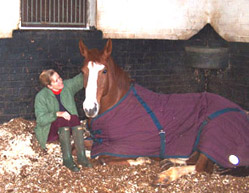
THERE is absolutely no reason why the horse that is primarily stabled-kept cannot be kept happy and content. |
 |
OTHER factors must to be taken into consideration when keeping the stabled horse a happy horse; it is not just the case of taking care of the feeding and exercise programmes – matters such as stable construction and bedding material also play an important role. There is a vast array of bedding materials on the market these days so there is something to suit everyone. Obviously much depends on individual circumstances such as ease of muck disposal. And stables should be light and airy with good "viewing" from the stable door.
THE aim of management is have a horse that is relaxed and content in his surroundings and in the peak of health. So a horse that is found laying down during the day is a sure sign that he is indeed a happy horse; many will not feel at ease enough to do this until after dark, just as some will not eat until the yard has stopped for the day. However course it is important to be familiar with the characteristics and behaviour of each horse so that it can be readily ascertained whether it is laying down because in fact all is not well.
The Horse at Grass
REMEMBER too, that just because a horse is turned out, it does not necessarily equate to him being the epitome of contentment; stress factors can also come into play such as lack of companionship, bullying by others, inadequate grazing, lack of shelter, etc.
|
MARES and gelding can be successfully turned out together provided you go about it the right way. WHILST we do not generally advocate the wearing of headcollars for turned-out horses, in this instance the mare is a tinker to catch and the gelding, who should know better, then decides to join in!! |

General Behaviour - Understanding the Individual
HORSES are naturally very sociable, easy-going creatures, so evidence of 'temperament' is an indication that all is not well, as the horse has no other means of communicating its feelings to us. And of course, it must be remembered that fear, apprehension and natural instinct play a big part in how a horse behaves and reacts to the challenges of life put before it. Also it is important to recognise that a horse may be bad tempered as the result of previous rough handling or physical abuse (in which case his confidence will need to be restored over a period of time), from the prolonged use of poorly fitted saddlery or the requirement to work when it has possibly been suffering from a physical ailment whether that be say a bad back, a gastric ulcer or something more subtle such as a food intolerance.
When horses first arrive we let them settle into their new surroundings but all the time we are noting their reactions to the activities going on around them, to us and to the other horses as by such observation we can quickly build up a study and assess the best way forward for each horse.
Handling – Correct handling of horses of any age is extremely important
HORSES are not naturally aggressive or confrontational so there is no reason why, when correctly directed during their initial training (at whatever age this is commenced), that they should not be well-mannered and polite. But if a handler is inexperienced, lacks confidence or is rough, misunderstandings and misbehaviour can be the result. Whilst it is easy to take liberties with horses that are naturally amenable, handlers should be experienced in the correct understanding and application of handling procedures.
WHILST all horses need clear boundaries, this is particularly important in the case of stallions; there is no in-between. This does not mean that they should be over disciplined unnecessarily - too many stallions are too harshly handled; it just that the little bit of leeway that might be given to mares and geldings, can soon be taken advantage of by a stallion.
STALLIONS need their turn-out and freedom as much as mares and geldings; in fact probably more so because of their physiologicial make-up. FUN in the field - whilst this young Welsh Cob stallion is letting off steam and doing no harm, this can turn into inappropriate behaviour at inappropriate times through no fault of his own if he is not correctly managed. High spirits are acceptable, allowed and of course completely natural but signs of aggression or assertiveness must be nipped in the bud. |
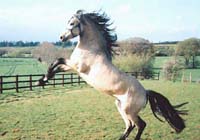
We evaluate each horse entrusted to our care for training and provide
constructive, practical explanation
as to the best way to keep your horse
a happy horse.
Footnote
THE physical and welfare needs of the unridden equine are just as important as those of his ridden counterparts and should be addressed in exactly the same way.
|
|
INDEED, with respect to the "minis" such as Thomas here, standing a mere 28 inches, special attention needs to be given to the diet to avoid such problems as laminitis. |
ATTENTION to teeth and feet must not be neglected (nor can a proper worming programme) although sometimes it can be a little tricky finding someone prepared to go onto bended knee! |


In Conclusion
WHETHER a horse is in work, at rest or retired he needs properly looking after. Yes, sometimes it can seem difficult to get to the balance of, say, feeding correct or source the cause of a change in demeanour but it is absolutely paramount that everything that affects a horse's quality of life is addressed.
ONCE all the physical and practical aspects of equine management have been addressed it is time to turn our attention to the training. So please click through to the next section.
WHATEVER YOUR TRAINING REQUIREMENTS, PLEASE CONTACT US FOR FURTHER INFORMATION
TWO PUBLICATIONS WHICH WE HIGHLY RECOMMEND
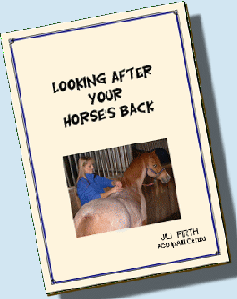 |
Jiill Firth from Back-in-Balance has produced a wonderful book(also available on disc or to download) to help you help your horse. The horse's back is influenced by so many things - not just saddle fit, but also his conformation, his training, shoeing, and his fitness levels. Plus he is also affected by his rider. Often issues that a horse has go unnoticed even though they may be causing physcial discomfort because, as said above, horses have a great ability to compensate and suffer in silence; instead he just gets a bad name for seemingly having behavioural problems or he suffers in silence! Jill's book shows you exactly how to look after your horse’s back, what factors affect the back, what may make your horse have a back problem and what to do about it. Please visit www.back-in-balance.co.uk for more information. Or to purchase your copy please follow this link:www.back-in-balance.co.uk/horse_back_problems.htm |
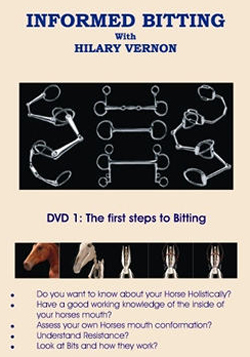 |
Renowned independent Bitting Clinician Hilary Vernon has produced a very useful DVD; a second is in the pipeline. Bitting is now a science and long since gone are the days of using a single jointed snaffle on every horse in the yard! Today much attention is paid (or should be) to mouth conformation to ascertain why types of bit a horse will be comfortable in. Then begins the task of deciding on what type of bit - and there are so many to choose from before you even begin to look at the multiple option for a double! From this DVD you will learn about all the factors which infuence bit choice rather than relying on what you think your horse should go in. Please visit Hilary's website www.equestrianknowledge.co.uk for more information and details of how to purchase this invaluable reference material. |