THE RIDDEN HORSE
NOTHING is more enjoyable than riding a well-mannered horse. Whether or not you choose to follow the competition route it is important that your horse has a clear understanding of how to behave whilst under saddle. This is of primary importance from the moment you set foot in the great outdoors as the countryside is not the quiet, peaceful place it used to be. There are hazards galore from barking dogs, fast cars and big lorries to pushchairs, umbrellas and wheeliebins! And if you come across a log that has just got to be - well you want to know that your horse has the same opinion!
|
|


HOWEVER it takes time and correct, well established training to produce a horse which is responsive to the aids, accepts a contact and is polite. The journey from the unbacked youngster to the confident, respectful riding horse can sometimes be lengthy and, at times challenging, but is nonetheless extremely rewarding.
THE importance of working with and training each horse according to its individuality cannot be stressed enough; training programmes and methods must be flexible.
Backing
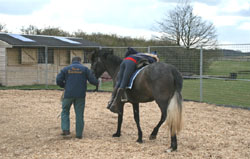
BY THE time a young horse is actually ready to be backed it will have been through the various ground training stages so that it has developed a stronger physical structure and so more able to carry weight on its back. Throughout the ground training period we are constantly assessing a young horse's development so that the right time can be chosen actual backing for the particular individual and the transition is as smooth and easy as possible.
WE STILL prefer to carry out the backing process over several sessions rather than taking the approach that "today is the day". In other words we will have spent time preparing the young horse for being sat on. Usually leaning over and then ultimately sitting astride a young horse does not present any difficulties if sufficient preparation has been done but however there are always the exceptions even if no specific reason(s) is evident other than the horse just being wary of the process. Unfortunately though, quite a number of the horses that find themselves with us have had their early training started by someone else and something has gone wrong in that horse, handler or both have managed to frighten each other; this results in a lack of confidence and a worsening of the situation.
WHEN a young horse decides that it really does not want someone on its back whether by being unhappy about being leant on or reacting once someone is on top, depending upon what has gone wrong, it can sometimes take quite a while to restore confidence. As with any situation that has caused a horse to become tense, stressed or actually frightened, it takes considerably longer to restore the status quo. This is why those who are not experienced in backing young horses pass the task to those that are. It is so important that equine training is only undertaken by those with adequate experience as sadly it is not uncommon for a horse to be mentally scarred to such an extent that he never does fully overcome his trauma. |
 |
Riding Away
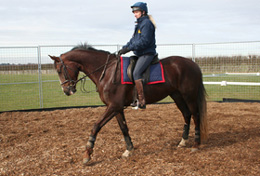
OUR round pen is considerably larger than most and even the largest of horses can be jumped in it. So we always ride young horses away away for a few days in there. IT provides a safer working space than the school should a youngster decide that it being off the lunge line is all just a bit too much! |
 |
Early Ridden Work
THIS is really is confined to simple rein changes in walk and trot whilst the young horse learns to balance himself once again under the weight of a rider. Once the horse has established that balance again, then we can begin to influence his way of going and the outline he makes.
HORSES vary considerably at this stage as some adjust much more quickly and begin seeking a proper rein contact sooner than others, but whatever the speed of development, maintaining free, forward movement is our main concern at this point.
THIS 4 year old Fleetwater Opposition mare, as with all aspects of her training to date, is very forward. HOWEVER although she is carrying herself well, when ridden she is still a little "rolling" in her gait. In other words despite her outward appearance, she is still weak behind the saddle. CONSEQUENTLY we will alternate long reining work with ridden work so as not to strain muscles - coupled with some loose jumping for variety, |
|
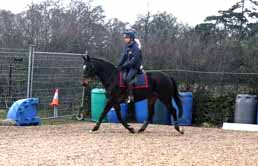
CONFORMATION and breed characteristics (combined with temperament, character, etc.) play an important part in how the young horse reacts and develops at this stage of their training. Some horses need longer than others to master the basics but this does not mean that there is anything wrong with the horse - just allow them more time.
|
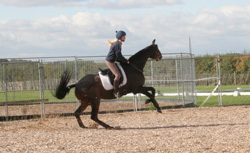
"ADAM", a 4 year old, is destinated for a career in Eventing. |

REMEMBER that a horse cannot be expected to come out of its stable and "drop" into the perfect outline straightaway. Time must be allowed for muscles to warm and loosen and the horse given a chance to relax before he is asked to start work proper. And, as with ground work, a horse cannot be expected to control his energy, excitement and exhuberance all the time under saddle; there are times when he should be allowed to express his emotions. Horses are not robots and should not be treated as such.
|
HOWEVER there is a clear distinction between the horse that is just playing and one that is trying to go riderless! |
Flatwork – 'builds muscle and improves balance'
EVERY horse can have its way of going improved by the correct execution of flatwork. Unfortunatley there are many people who think that they are working their horses effectively and efficiently. All too often though we see horses that are set in a fixed outline in front with nothing going on behind the saddle. Ridden flatwork is very important for all horses whatever their purpose be it for hacking, driving, dressage, etc. Attention to the rider, suppleness of the body and free, forward movement is the aim. We obviously do a considerably amount of flatwork but as we are mindful that some horses can switch off, we use varied routines and incorporate all sorts of exercises to maintain interest as well as aid learning.
INDIE is a former point-to--point horse. Unfortunately his proved not to be his forte and he fell more times than he remained standing. Left to his own devices Indie uses the muscles on the underside of his neck to prop himself up. . HE is a little thick in the jowl making flexion harder for Indie him than some horses. He also has another conformatory issue - his left hind leg is bowed and even when trotting on straight line, the leg is crossed underneath his body which makes cantering Indie's hardest pace. |
|
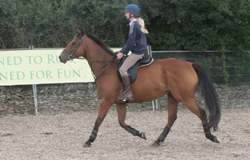
AFTER several weeks of long reining, incluing raised polework, Indie is now back under saddle. HE does have attitude and needs very positive direction otherwise he will readily adopt his preferred way of going HOWEVER as can be seen from the photograph, Indie is now supple enough to round up and engage very well and he is able to compensate very well for his bowed hing leg. What a difference a couple of months can make! |
|
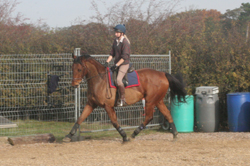
THE gelding pictured below had become tense and confused resulting in him constantly dropping his head way behind the vertical or virtually between his front legs; his behaviour generally deteriorated and he became a 2dressage reject". Long reining was initially used to open him up and encourage him to adopt a lowered but stretched outline. When work recommenced under saddle, the tendency with the head carriage returned the moment a true contact was taken.
AFTER many months of extremely patient work, Oscar is once again a happy horse and a joy to ride. HE is moving happily forward into a soft contact but with a nice open frame. He is accepting of the leg and no longer shows the resistances that caused so many problems in his past. ALTHOUGH already trained in elementary/medium level dressage movements, this horse has had to be taken right back to the very basics of early ridden training in order to break his less desirable habits and restore his confidence, both in himself and a rider. |
|
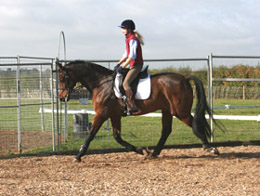
THIS horse, whilst seemingly presenting a nice picture, needs to softer and adopt a rounder, deeper outline. If you visualise where the right hind leg will land, he is also not stepping under enough. IN the case of this particular horse, this is because he is not yet warmed up enough and is still tight in his back (mainly due to injuries incurred when racing). THIS horse also needs to be more "off the leg" but as an ex-racehorse the horse must also be taught that "off the leg" does not mean go faster! |
HAVING given the horse a canter, incorporating counter-canter, executed some lateral exercises (also in canter - leg yielding - both down the arena sides and across the arena and on a circle) he is now much looser and so trainin proper can commence. THIS illustrates the need to know your horse and how best to warm him up (however unconventional the process). We could trot round all day andask him to round and deepen but achieve nothing; pop in some canter work first with some lateral exercises and we now have a horse that is one the bit and ready to work. |
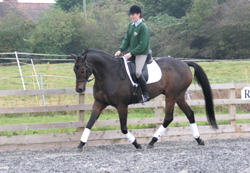
PRODUCING the riding horse is a gradual process. You cannot back a horse one week and expect him to be skipping across the school in half pass the next! Remember- horses develop at different rates so allow for this most important factor. It is not only age and breed which are influential - you are dealing wih an individual.
|
|

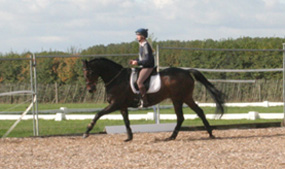
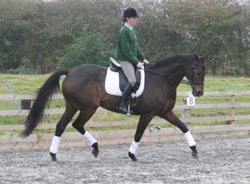
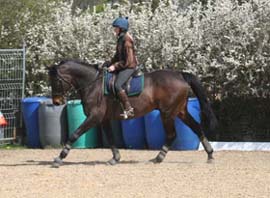
THE warmblood gelding on the left presents a very pleasing picture. He is loose through his body and has a soft outline with a lovely lateral bend from nose to tail. The thoroughbred on the right also presents a lovely picture; two different breeds of horse, each performing correctly but entirely differently.l
 |
 |
TRAINING horses is a journey - there is always room for improvement but not for complacency!
BUILDING suppleness, attaining flexion, establishing straightness and achieving collection are effectively a journey, a most wonderful one, albeit challenging at times!
THIS gelding is already supple, good to the leg and active behind. However he sometimes is not always straight. By subtle shoulder-fore exercises Fred is keeping the horse's body straight. |
|
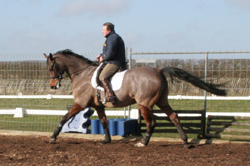
SCHOOLING is not just to further a young horse's education or improve the way of going of an older horse; it is also an important factor in rehabilitative work.
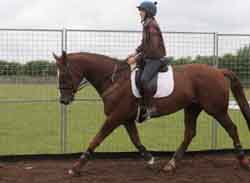
FOR the horse that has had a lengthy period of time off due to injury (or just a long rest period generally) then they need to be quietly brought back into work as care must be taken not to put strain on muscles, ligaments and tendons that have lost their strength. THE horse featured here has had a catalogue of veterinary treatments in an attempt to establish why he can be randomly extremely reactive without any warning readily ejecting his riders. He has had extensive long reining to strengthen his back and build his topline prior to being ridden again. |
 |
RIDING is potentially dangerous but we can minimise the risks by having horses that are as well behaved and obedient particularly if you wish to ride out on the roads.
|
HOWEVER a horse cannot be expected to work enthusiastically in the school environment every day so it is important to vary the working locations to provide interest and variety. There are many distractions but the horse should be equally attentive and remember their manners when working in open spaces.This not only makes riding them a more pleasurable experience but is important as regards safety. |
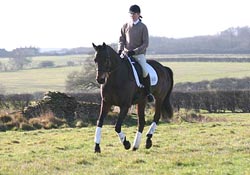
JUST because a horse is older does not preclude it from being able to undergo further, corrective or remedial training. Usually they have just lost their way a bit and so have become rather stiff and rigid in their outlines. Of course it is just as important to ensure that saddlery is correctly fitted and the horse is appropriately bitted as it is with the young horse.
THE mare, "Beth" pictured below had lost her agility and suppleness; she was rigid and tense, literally setting herself against the bit which, at the time of her arrival with us, was a Pelham. She did not seem to understand the aids and how to react to them; consequently she lacked so much confidence in herself and and her rider which was, understandably, affecting her jumping ability.
 |
THE first thing to do was remove the Pelham, and use a saddle that fitted correctly. After a thorough check over by our chiropractor, we commenced work. |
OF COURSE flatwork can be kept very simple and basic, but by introducing leg yielding and lateral work, schooling not only becomes more interesting and challenging for both horse and rider but also develops a more supple horse, teaches him to be more responsive and obedient to a wider range of directional cues (aids) and also sets in motion the ultimate aim of all ridden flatwork – achieving collection. See "Dressage" below.
|
FOR horses that are primarily jumping horses, as opposed to those that are directed towards dressage, then their schooling work must be adapted accordingly. For example, it is important that a horse can maintain its impulsion and balances whilst turning the tightest of turns in a jump off. |

Polework
WE do not restrict polework to ground training work only; it is as equally important for the ridden horse except the horse benefits physically even more because he is executing the exercises carrying the added weight of his rider.
POLEWORK can be executed in 'stretch' or collection; by laying poles in different ground patterns we can achieve a varying range of results. We also work horses over elevated poles when they are suitably advanced enough to cope with the additional physical and mental effort such exercise exerts.
|
|


THE gelding on the left is just warming up over the poles; Rowena is sitting very lightly (and well inclined forward) to allow the horse to loosen his back muscles; the horse has a nice open outline and is paying attention but is not really working whereas the gelding on the right, suitably warmed up, is using himself well - a super outline with clear hock engagement and suppleness through the back. Hence Rowena is able to adopt a compeltely different position in the saddle.
THE natural progression from polework is an introduction to jumping which is covered in the next section.
Dressage
WORKING and training a horse beyond negotiating basic movements to the higher levels of engagement and collection is a patient task but worth every minute of the tremendous amount of time it takes. Whilst a horse may well, for example, be able to execute shoulder-in and simple changes, it is the quality of the movements which is so important alongside suppleness, softness and elasticity; as time passes the simple movements just get better as the horse progresses to travers, half passes, tempi changes, pirouettes, etc.
DRESSAGE is accessible to everyone but if you want to be a "serious" dressage competitor then regardless of your training and riding abilities you will really need to be under the regular and watchful eye of a trainer. Everyone needs someone on the ground to ensure correctness and accuracy.
ROWENA and "Light the Fuse" (Bombie), an ex-racehorse, apart from working at home under Fred's watchful eye, are regularly put through their paces with dressage trainers. Despite having to overcome the effects of his numerous racing injuries, Bombie is progressing well as he learns to take more weight behind - Medium level is beckoning!
|
|
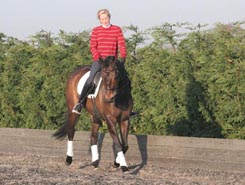
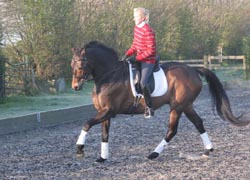
DRESSAGE competitions cover all levels and abilities so don't be put off if half passes and pirouettes are beyond your capability; you can still go out there and have a lot of fun - there are now tests where you do not even have to canter!
|
TO HELP with training issues there are plenty of Clinics and Demonstrations taking
place around the country covering all aspects and stages of training. There are also Regional Training opportunties. ALSO there are trainers for horses and riders, such as ourselves, to provide hands-on help. WHY not become a member of British Dressage? Please visit the BD website. |
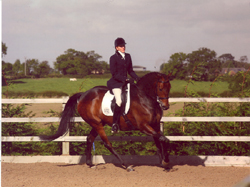
| THE Equine Affairs website contains all the information necessary to get you out and about to clinics and demos and onto the competition circuit, whatever your chosen level. |

In Conclusion
HOPEFULLY we have managed to stress the importance of giving the young horse the right start in life. Its early ridden work and how it is effected will remains with a horse throughout its life. Just as people do not ever forget how to ride a bike, likewise a horse does not forget how to be ridden - and nor does it forget what it went through to get to the stage in its life!
Footnote
A CAREFUL study of all the photographs on this page will show that all the horses featured are in the simplest of bits and nosebands. We very rarely use a flash noseband, and when we do it is there only to help the bit up in the mouth of young horses.
WHATEVER YOUR TRAINING REQUIREMENTS, PLEASE CONTACT US FOR FURTHER INFORMATION