TAILORED TRAINING
OBVIOUSLY competition horses require dedicated training relative to their particular sport; however certain other spheres of equestrianism also requires specific training in order for the horse to be able to give of his best, such as Grading, Pre-Race preparation, etc.
THE following provides an outline of other training that we carry out.
Grading
THE various
breed societies such as the SHB(GB), BWBS, BHHS, etc. have specific
criteria to help maintain high breeding standards and impeccable blood
lines. Such specifics that are taken into consideration are conformation,
pedigree, ability and "personal" qualities such as temperament
that a horse will pass to its progeny. A horse has to fulfill these
criteria and also show off its talents or potential for its chosen equestrian
sphere be it dressage or show jumping. Horses have an extensive
veterinary examination prior to the day of the grading.
A
GRADING day will typically involve a trot up and then jumping
(loose-jumping for 2/3 year olds, under saddle for 4 year olds and over)
or the performance of a short test for the potential dressage horse. So a horse is judged not only on its physcial make-up (i.e. checking it is conformationally accurate and sound) but also its manner, attitude and behaviour (i.e. a good temperament to breed from); style and technique are also taken into account.
 |
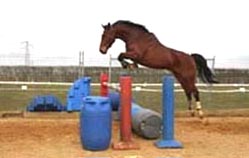 |
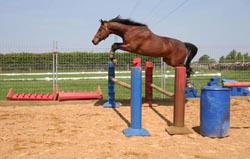
WITH careful training a horse that clearly has a jump in it can have his technique improved - compare the two pictures. However we would now like to see this horse open a little more through his neck.
[For jumping horses, whether loose or under saddle, please ensure that your surface provides a suitably secure and supportive footing. Some surfaces have limited capabilities. Having had woodfibre, silica sand is now our preferred choice.]
Preparation of Horses going into Training
A HORSE going into training needs to learn more than just galloping about! Life in a racing yard is vastly different to hat of any other form of training or livery yard.
THE daily routine is very structured and there are specific things that the horses have to accept so the more we can prepare them for these, the less of a culture shock for them when they go into training.
 |
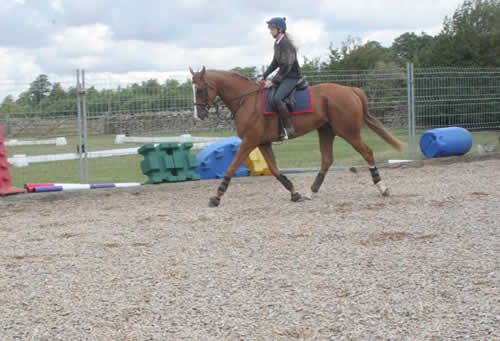 |
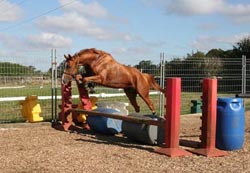
THE gelding above is by Silver Patriarch and as he will go hurdling teaching him to jump is an important part of his training. We also like to carry out so very basic school work to help with balance and co-ordination and to build strong, muscle in the right places.
Showing
WHILST you may not consider there is much to teach a horse for in-hand showing, if you want to be up there with the professionals, then rest-assured there is plenty your horse can learn in order for him to stand out from the pack.
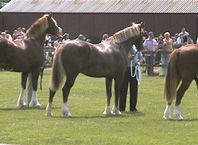 |
THE teaching of impeccable ground manners is of great benenfit in the show ring to ensure that you remain in control when all around you could ready disintegrate into chaos! IN-HAND horses should be able to stand still for considerable periods of time and be happy to do so within the close confines of other horses and with plenty of distractions. |
WHAT your horse learns for his in-hand classes will only be of benefit should be progress to ridden classes as he will still have to perform an in-hand lead up for the judge.
Rehabilitation After Injury, Etc.
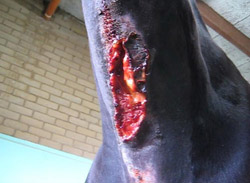
WE do not carry out therapeutic treatments here other than those of chiropractory and physiotherapy. However we accept horses following all manner of operations - and prognosis.
OUR work is based around getting the horse working again whether that be its first steps into the fresh air following a period of box rest or recommencing ground work in prepation for riding + of course the actual ridden part as well. PLEASE follow this link for more information on some of the cases we have managed. |
WHATEVER YOUR TRAINING REQUIREMENTS, PLEASE CONTACT US FOR FURTHER INFORMATION