HORSETALK
So you want to Breed – Think Carefully!
This article is not aimed at the professional breeder, instead being intended for those thinking about embarking on their first enterprise and those who perhaps didn't get it right first time around. It is not comprehensive in terms of all the things you need to know about and what you should do, it is merely a guide.
___________________________________________________________________________________
You've got a mare and one day you decide it would be rather nice to have a foal from her - why?
This is the question you must ask yourself in all seriousness. You should be able to give several very good reasoned answers to that one question.
So why would you like your mare to have a foal?
"It would be fun" is not a satisfactory reason alone for embarking on what is really a serious exercise. Yes, of course it is fun and a wonderful experience but there's more to it than the dreamy images of mares and foals lazing about in summer meadows. Bearing in mind that within, for example, the TB industry where the breeding lines are meticulously studied for the best possible outcome there is still a vast turnover of horses that just ""have not got what it takes", what is the likelihood of breeding something "special" yourself? There is far too much indiscriminate breeding just for the sake of wanting to have a foal. That is a consideration in itself. And the fact that you just don't know what else to do with your old mare is not reason enough either.
So sit down and jot down your logical reasoning behind the idea – be objective. Forget for a moment you are the owner of the mare and look at her from an outsider's point of view.
Temperament
This is important for all the obvious reasons but also because it is from Mum that a foal begins its journey along the learning curve of life so if she is good-natured and quiet, the foal will pick-up on this a follow her guide. Even if her temperament is not genetically passed on, a foal will mimic its mother's behaviour patterns. Also, if Mum is highly strung she is less likely to be a good mum and there is of course the risk that she will not conceive at all anyway.
Conformation
The anatomical structure of the horse determines its conformation such as turned in feet, slack pasterns, sickle hocks, parrot mouth, etc. Any deficiencies in Mum could well be passed on. Whilst conformation influences the way a horse moves it does not necessarily follow that perfect structure equals superb movement, so don't be overly worried by the fact that your mare does not have the action of a grand prix dressage; good training and schooling of the young horse can improve the way a horse moves anyway provided is not, say, a joint problem which is restricting the ability of the stride to be lengthened.
Breed Qualities
Is she a good specimen of her breed (if she is registered)?
Talents
Has the mare excelled at anything or at least shown good ability?
Good Bloodlines
Your mare may well be from an excellent bloodline herself or from an older bloodline that is in decline so you may wish to perpetuate it. Fair enough.
So you've rationally thought the idea through, you've good reasons for wanting to breed; the next stage is considering ….
Is your mare actually physically fit to breed from?
Age
If you have decided to retire your mare because she "is getting on a bit" think long and hard as to whether it's fair to put her through pregnancy at such a late stage in her life, especially if it is the first time for her. The physical risks are much greater and once again there is a higher risk of her not conceiving anyway. Better to have a foal when she is younger and then bring her back into work.
Physical Problems/Unsoundness
Have you retired you mare because of an injury that will be exacerbated by her pregnant condition or cause her undue stress? If a physical problem is present, is this as a direct result of a conformation defect – poor conformation may predispose an unsoundness - or of some unrelated accident in which case it won't be inherited?
Condition
If she is older, is she physically fit to cope – e.g. arthritis, which would make moving about and getting up after a lie down more awkward once the mare is heavily in foal. Arthritis may have its roots in poor joint structure and be not just as a result of a hard working life or old age so look into the cause carefully. Is she in poor condition perhaps after a harsh winter or is she a good/bad doer? A poor feeder may not pass on sufficient nutrients to the foal being carried. Or maybe she is on the large side; remember that if a mare is fat inside it can inhibit conception. That is why in the TB industry mares are sent to stud the moment they finish racing while they are still fit.
For the first time mare it is worth obtaining the advice and opinion of your veterinary surgeon as to whether he considers the mare to be a suitable breeding prospect and to check that all is well internally before sending her off to stud – the presence of cysts for example could affect the pregnancy in some way resulting in the foal being aborted.
Having decided that your mare is a good prospect – there are then …..
Other considerations before committing yourself
There is the care of the in-foal mare to think about. A good worming programme is even more important, additional nutrition may need to be provided, etc.
Will she foal at home? If so, do you have suitable facilities? There is nothing wrong with an outside birth but a suitably large stable or similar should be available in the event of an emergency or if the weather is particularly harsh (you can be assured that the mare will most likely foal in absolutely rotten weather – that's what they do best!)
It must be borne in mind that once a mare has a foal at foot, particularly in the early days, there can be, but not necessarily, tensions in the field with the horses that are normally her pals. Another mare may try to steal the foal from its mother - and it has been known for geldings to do the same; mature horses may not take too kindly to the presence of a youngster either so there is the risk of physical harm being done to the foal and of course to Mum as she tries to protect her baby. The best course of action is to have Mum and baby on their own for a while to make sure that they have bonded properly and then introduce them into the open field with company.
If you intend to let the mare foal outside, obviously you will be keeping a watchful eye in case of complications, but again, at the time of birth if in the field with others, another mare may try to "step in" and the new born foal may not get a chance to take its vital first feed from mother containing that all important ingredient – colostrum.
Do you have any experience of breeding or have someone close by that has whom you can call upon?
There is not only the general management of the in-foal mare, what about the actual birth process? Even if you do not intend to manage on your own, there is always the risk that the mare may go into labour early, so you should have some idea of what to do whilst awaiting assistance. Once labour begins, provided there are no complications, the whole process can take as little as 20 minutes which does not allow much time for your vet to arrive. So Be Prepared. |
|
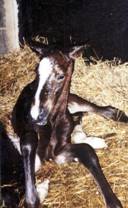
Foals are extremely inquisitive like any young animal so fencing and gates have to be especially secure and you need to be even more diligent about ensuring the field remains a safe place for a youngster to play. More of your own time will be invested in management, have you the time available?
You then have to think about whether you are experienced or capable and confident enough to be responsible for the first steps on the training ladder of the foal. The onus is on you to teach him the basics - lead, tie up, pick his feet up, etc. |
|

And what of weaning? That is an issue in itself and requires careful planning to ensure that both mare and foal are as least stressed as possible. There are various views on the best way of carrying out the exercise and people have their own preferred method. This will be a topic covered in a later edition of Horsetalk.
Then of course there are the financial considerations. Deciding to breed is a long term commitment. Apart from the initial stud fee there are all sorts of on-going resultant costs – e.g. care specific to the in-foal mare (ultrasound examinations), vet's fees for delivery of the foal plus attention if things do not progress properly during the pregnancy. There's also routine veterinary care of the new foal, along with additional farriery, stabling, feed and grazing costs. After that comes the decision about the even longer term commitment, that of whether you will keep the foal through its early years and then break it in (or have someone do it for you) or will you sell it on?
Once you thought carefully about the mare and the input required from yourself, you can then turn your thoughts to ….
Selecting a Stallion
So Flossie is to be a mum, you can cope, so now to choose Dad. This has to be done as the same objective exercise as it was for the mare, evaluating what you are looking for and aiming to achieve.
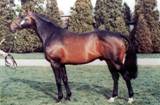 Gambler's Cup
Temperament
Dad's nature and demeanour are of equal importance to that of Mum; his genes may prove to be the stronger so the foal will take after its father rather than its mother.
Conformation/Physical Defects/Unsoundness
As with judging the suitability of a mare these three points are inter-linked, for example a physical defect being exacerbated by poor confirmation; blindness in an eye might be an inherited defect or as a result of injury.
The secret is to try and evaluate any unsoundness to assess the potential risk. In simplistic terms, if the stallion is prone to lameness after fast work but is o.k. during a "normal" exercise programme and you are not planning to breed the next Derby winner but instead a potential show horse, then it is unlikely that the cause of the defect is inherent and even if were, for your choice of use it would not be a problem anyway; if however a racehorse is the aim, then you would think twice about choosing that stallion.
Talents
Has the stallion excelled at anything in particular? This of course does not mean that his capabilities will be passed on but it helps in the decision making.
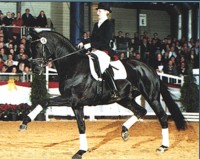 Dondavidoff
Offspring
Check out any prodigy. This enables you to see if the attributes and abilities of the stallion are reliably passed on. If several offspring show the same weaknesses then you can be sure that the "blame" lies at the hooves of the father. The stallion himself might not have any untoward "grey" areas but he may well pass something unsuitable to his offspring, i.e. the "inheritance" genes might skip a generation. e.g. the stallion may well be good natured but all his offspring, as was his own sire, turn out to be not so even tempered. Do your homework as there may be a disease within the family line that is not passed on to all offspring but the danger is there nonetheless, such as wobbler syndrome.
See the stallion
With the enhancing abilities of a computer, photographs cannot be relied upon to be truly accurate so it's best to try and see the stallion in the flesh, but at least on video.
Size
If Mum is barely 15.2 you can't put her to a stallion that stands 17.2hh! Even if you choose AI, the mare will not physically be able to give birth to the likely large foal.
Age
If the stallion is young with no proven record of what his offspring are like, then look back a generation to the parentage on both sides and see what has resulted.
The Next Step
Once you have the good and bad points to hand on both sides of the equation you can then assess the possible outcomes.
Select a stallion that compensates in any areas your mare has a weakness and of course, vice versa. For example, if your mare is a bit stuffy in the neck, you can pick a stallion that has a long neck. Your preferred may not be the stallion that is best suited for the mare so have a few on your list of possibilities.
However carefully you make your evaluations there is still the element of the unknown as at the end of the day as nature plays the most important role of all, but you can reduce the risk of producing a foal that has a problem or defect.
Deciding to breed a foal is a big decision, but once committed, the whole experience is very rewarding. So if you have the management skills and facilities – go for it and ENJOY.
* * * * * * *
_____________________________________________________________
These articles will cover all aspects of equine management and training but are only intended to provide a guideline and are not to be construed as a substitute to seeking professional advice for individual situations.
________________________________________________________